
Guest Blog: Looking beyond the EAL label – Analysing learner data
November 16, 2026
In this guest blog, Katherine Solomon, Director of Programmes and Partnerships at The Bell Foundation, explores why looking beyond the EAL label can help schools better understand their pupils’ attainment, progress and support needs. The views and recommendations expressed are those of The Bell Foundation.
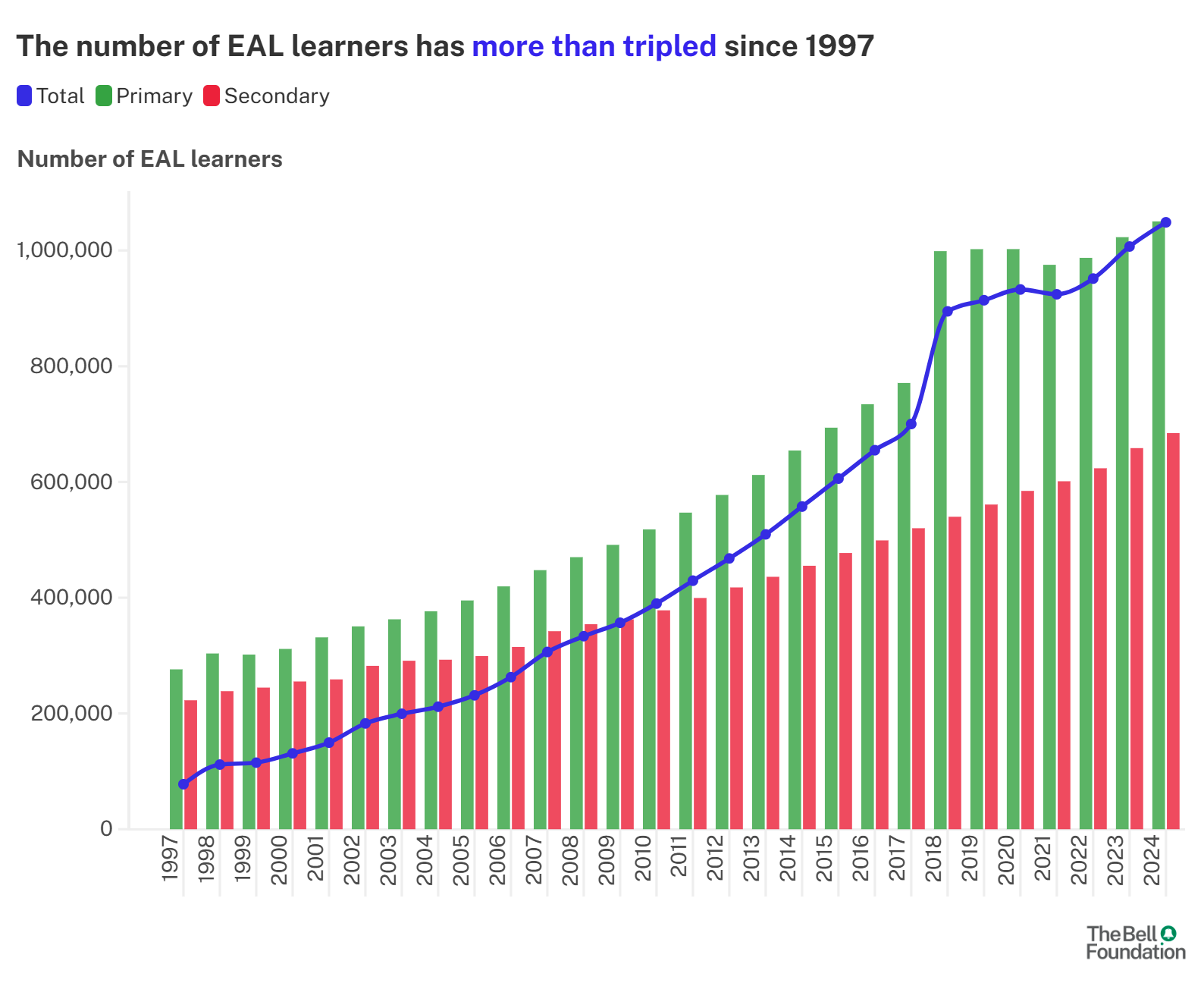 Source: The Bell Foundation
The number of pupils who use English as an Additional Language (EAL) in England has tripled since 1997. With over one in five schoolchildren now speaking EAL, more schools across the country are working with multilingual learners.
But how useful is the term "EAL" for schools? The way that EAL data is collected and reported through the school census reduces a highly diverse group of pupils to a single binary label: whether a learner speaks another language at home or not. This information provides only a broad overview of EAL learners in England. It obscures significant diversity in pupils’ experience and proficiency in English, and tells schools very little about a learner’s starting point and support needs.
For example, while some EAL pupils overperform, the aggregate data masks the barriers faced by many EAL learners, some of whom require significant support and experience notable attainment gaps compared with their monolingual English-speaking peers.
As a result, schools that rely on the broad categorisation of “EAL” will have limited insight into individual learners and will be less equipped to identify needs and target appropriate support. Assessing learners’ English proficiency, as well as taking note of other factors, such as time of arrival, can add all-important context when looking at learner progress data.
Why is EAL assessment important?
Our 10 years of research has found overall that it is the ability to speak English well which has the greatest impact on the attainment of EAL schoolchildren – more so than anything else, including ethnicity, socio-economic disadvantage, or gender combined.
Understanding a child’s current proficiency in English can therefore provide valuable context and help schools identify how best to support EAL learners to access the curriculum and achieve their potential. Implementing ongoing assessment of proficiency in English can help schools to adjust support plans accordingly as students develop their English language skills over time. This is especially relevant now that Ofsted’s Inspection Toolkit for Schools explicitly considers whether schools assess pupils’ English language proficiency as part of their provision for EAL learners.
How can schools accurately assess and support EAL learners?
So, we know that the term "EAL" is not enough on its own to indicate a pupil’s need for language support. Schools must be able to accurately identify each learner’s individual needs so that they can determine the length and type of support required to meet their learners' individual language development needs.
Here are three strategies that schools can adopt to ensure ongoing, consistent, and reliable teacher assessment of proficiency in English:
Implement initial assessment
To conduct an effective initial assessment of pupils’ proficiency in English, schools should also consider the following aspects:
Collect useful background information: The initial induction meeting, and tools such as The Bell Foundation’s EAL learner profile guide are great opportunities to gain a more complete picture of the learner including their prior educational experience.
Establish a consistent approach to assessment: It can take multilingual learners more than six years to acquire academic proficiency in English. Schools should therefore adopt an EAL Assessment Framework to provide a shared language and clear criteria for assessing English language proficiency. This helps ensure assessments are carried out consistently across classes, year groups, and staff, giving a more reliable picture of learners' strengths, needs, and next steps.
Monitor patterns in data: Use data from proficiency in English assessments alongside other core data (e.g. gender, ethnicity, pupil deprivation, specific language groups, SEND) to monitor rates of progress among groups of students. Variations in rates of progress need to be investigated and, where necessary, impactful language-focused interventions put in place.
Use robust EAL assessment tools
Robust EAL assessment tools will ensure consistency in how teachers undertake assessment and will go some way to reducing subjectivity. Using an EAL assessment framework gives practitioners a shared understanding of different levels of proficiency within the context of curriculum learning and provides a roadmap for progress.
The Bell Foundation’s free, evidence-informed EAL Assessment Framework for Schools can be used for initial and ongoing assessments. By adopting an effective whole-school approach to assessing an EAL learner’s progression, teachers across the school can share the responsibility for assessment and track all four domains of language use (listening, speaking, reading and viewing, and writing) to provide a broader and more accurate record of the proficiency level of the learner.
Provide relevant training
Given that assessment of proficiency in English is strongly influenced by the individual making the assessment, schools should take steps to minimise subjectivity and variation between individual assessors to ensure reliable assessment of pupils’ proficiency in English.
Engaging in high-quality CPD (such as The Bell Foundation’s free online course) and putting robust moderation procedures in place will support consistent and reliable EAL assessment.
What other factors should schools take into account when assessing EAL learners?
Each learner brings with them a unique set of strengths, experiences, and skills. Prior educational experiences, cognitive abilities, wellbeing, and proficiency across the languages they use can all influence learning and progress. Proficiency in English is particularly important because it enables learners to access the curriculum and demonstrate what they know and can do. Understanding these different dimensions of a learner's profile is therefore essential.
As mentioned, free tools such as The Bell Foundation's EAL learner profile can be helpful for schools looking to create holistic profiles that will lead to improved learning environments, wellbeing, and academic success for learners. Used alongside English proficiency assessment, this tool encourages schools to consider other factors such as:
The time that a pupil enters the education system
An EAL learner who was born and educated in England and is fluent in English will have a very different educational experience from a pupil who has recently arrived, is new to English, and is navigating an unfamiliar education system.
Pupils who arrive later have less time to develop the English language proficiency needed to access the curriculum and participate fully in learning before reaching key assessment points. Research suggests that EAL learners take more than six years on average to reach proficiency in English, highlighting the importance of early identification and support.
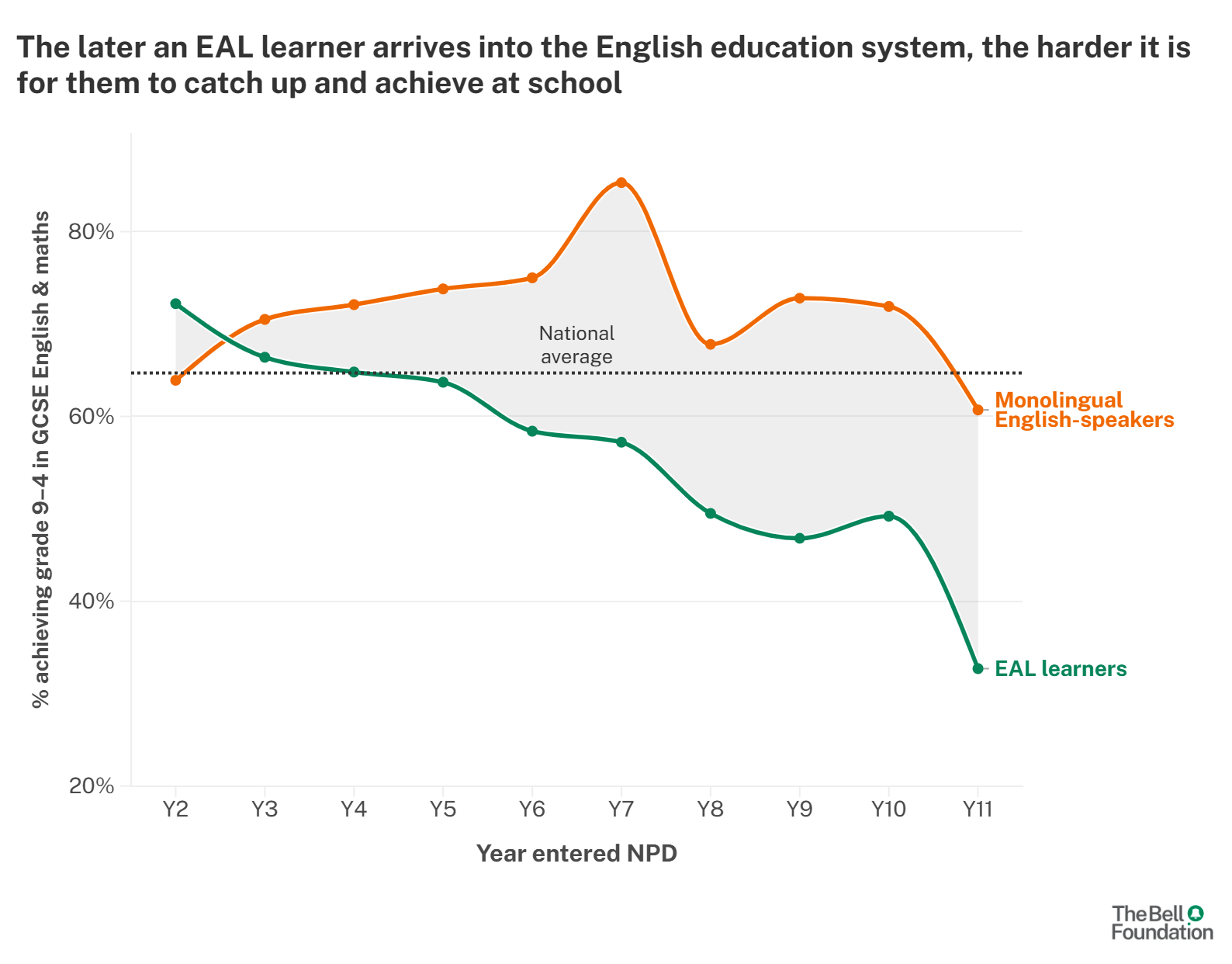 Source: The Bell Foundation
Our research has found that, unlike monolingual English-speaking pupils, EAL learners who join school at any time after year 5 have lower attainment on average by the end of year 11. As a result, this group needs targeted language support to bridge the attainment gap.
Varied backgrounds and educational experiences
Some learners, such as those from refugee and asylum-seeking backgrounds, may have experienced interrupted schooling or displacement. It is therefore important to gather information sensitively and recognise that every child's circumstances, experiences, and needs are unique. Developing an understanding of a learner's educational background, home context, strengths, interests and aspirations can help schools provide appropriate support and build on existing assets. Some learners may also have additional learning needs that should be considered as part of this process.
Languages spoken
The Ofsted Inspection Toolkit for State Schools expects teachers to recognise that EAL learners already speak at least one language. Some learners may already have knowledge of one, two, or even three languages other than English.
Understanding a learner's language profile, including the languages they use, their literacy and spoken proficiency across those languages, and their prior educational experiences, can provide valuable insights into the support they may require. It can also help schools identify and build on the strengths, knowledge and skills that learners bring with them.
EAL assessment is a non-negotiable for shaping tailored support for EAL learners at school. Rather than relying on EAL status alone, effective provision depends on effective assessment informed by an understanding of each learner's linguistic, educational, and personal background.
Written by Katherine Solomon, Director of Programmes and Partnerships, The Bell Foundation
About our partnership
The Bell Foundation is an Insight partner, with its EAL Assessment Framework available within Insight. If you’d like to learn more about accessing their framework in Insight, this help guide is a great place to start.
Katherine Solomon, Director of Programmes and Partnerships, The Bell Foundation
Get in touch
Insight offers a 60-day, no obligation, free trial. This includes a fully featured system and full support to help you get started. Import your pupils, historic data, and evaluate the system with your team.